Skip to content
Lab Monolayer Blown Film Extruder
Model
AT-P6110 series
Applications
It is used to “simulate” the plastic film production process of a large factory in the laboratory using small batches of plastic raw materials, to test the feasibility of blown film production, the quality of the blown film, and to optimize blown film formulation and process.
Small Film Blown Film Extrusion Machine Overview
A Lab Monolayer Blown Film Extruder, also known as a lab film blowing machine, is a small-scale plastic film production device specifically designed for laboratory research and testing. Compared to production-scale blown film machines, it has a smaller footprint, lower energy consumption, and lower cost. It can use very little material to simulate and verify whether materials can be blown into films, assess the effectiveness of formulations, verify the optimization of the entire blown film process, and confirm whether the performance of the produced samples meets required standards.
Through adjustments and optimizations, this machine is suitable for various plastic materials such as LDPE, LLDPE, HDPE, PP, PVC, PET, PA, POF, PLA, etc. It is an indispensable piece of laboratory equipment for plastics and chemical companies, masterbatch and additive manufacturers, universities, and research institutions.
Blown Film Principle
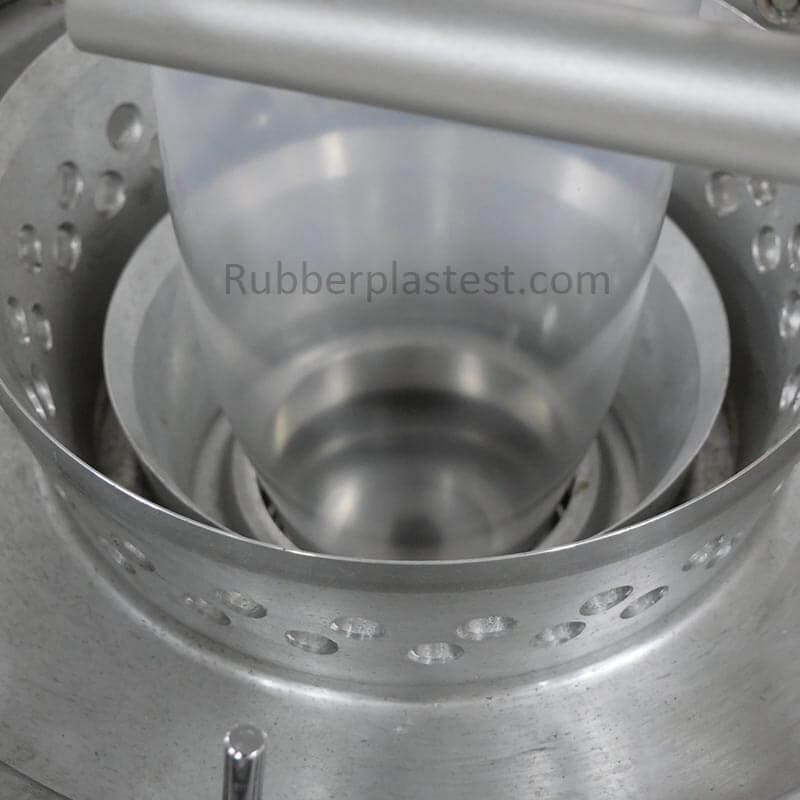
Plastic in pellet or granule is fed into the hopper of an extruder. Through heating and screw rotation, the plastic is melted and plasticized, and then pushed forward. The molten plastic is extruded from an annular die at the other end of the extruder, forming a “plastic tube” preform. Simultaneously, compressed air is continuously blown out from the center of the die, inflating and thinning the “plastic tube” like blowing up a balloon. The inflated film bubble is rapidly cooled and shaped by cold air blown from the bottom fan. The cooled film bubble is flattened by a collapsing frame, then passed through traction (nip) rolls and a winding device, finally being rolled into a finished film.
Detailed Description of Equipment Structure
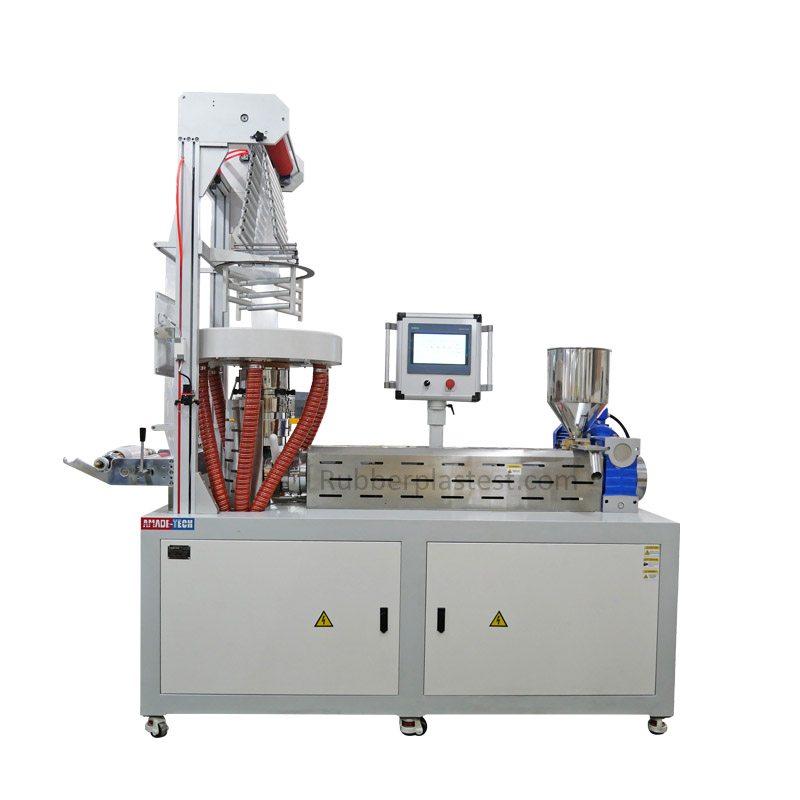
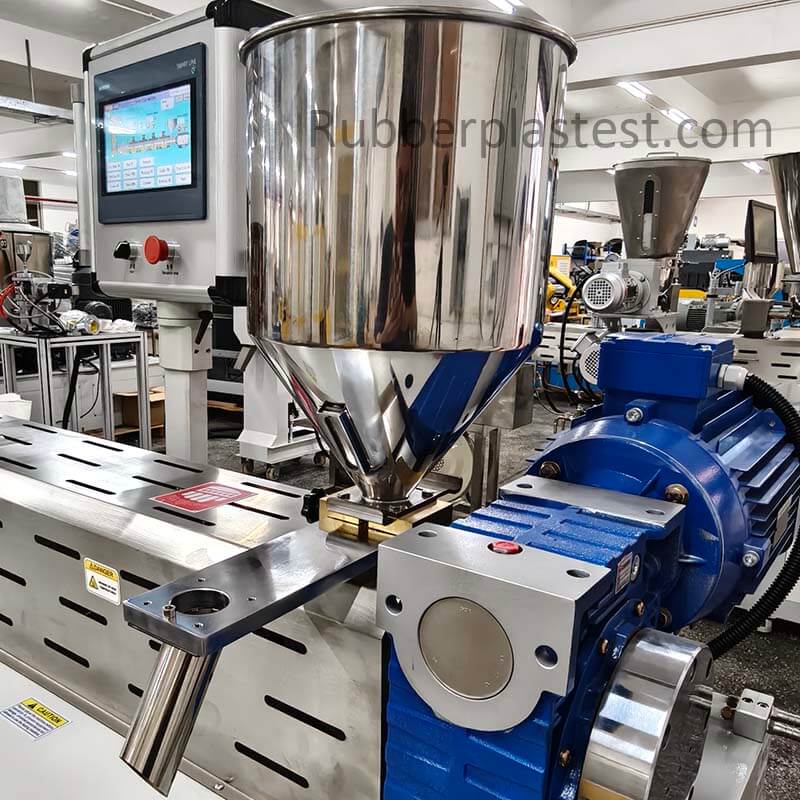
Our blown film extruder frame is welded from structural steel and stress-treated, resulting in high rigidity and minimal deformation. The surface is coated with a baked enamel finish, offering excellent wear and corrosion resistance. The machine is equipped with adjustable casters and feet for easy movement and securing. A standard stainless steel hopper with a transparent observation window is included. its unique design allows for quick self-unloading via convenient manual operation. The extruder screw and barrel are made of high-quality 38CrMoALA steel with a nitrided surface, enhancing hardness, wear resistance, and corrosion resistance. Specifications such as screw diameter, compression ratio, and thread shape can be customized according to the characteristics of the processed material and the film specifications to be achieved. The screw is driven by a high-power variable frequency speed control motor with a transmission box, enabling stepless speed regulation. The drive motor and reducer are directly connected, with the reducer output shaft connected to the screw for efficient transmission. The barrel is equipped with multiple cast aluminum heaters, employing multi-zone electric heating with independent temperature control for each zone.
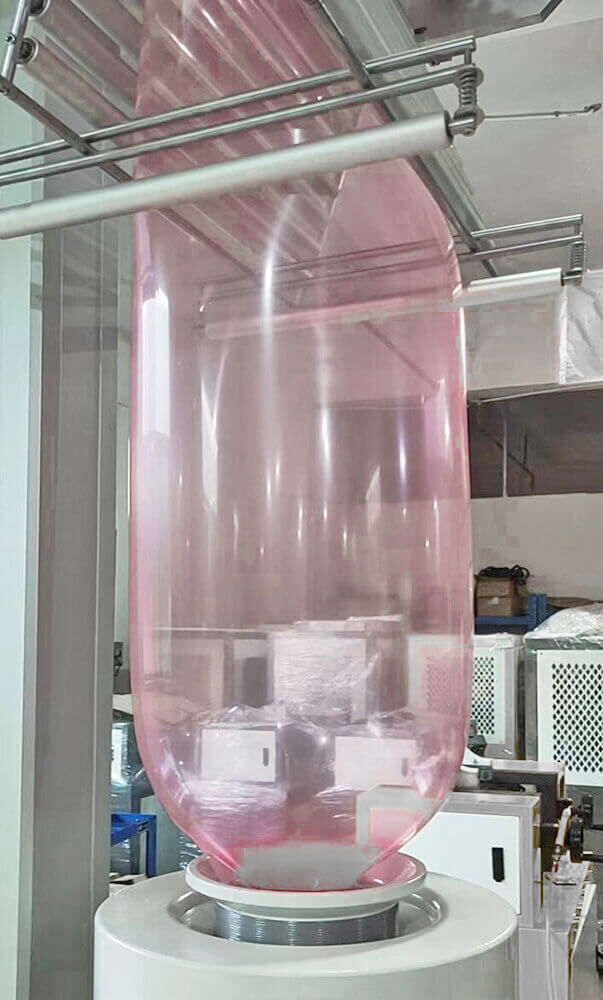
Blown bubble
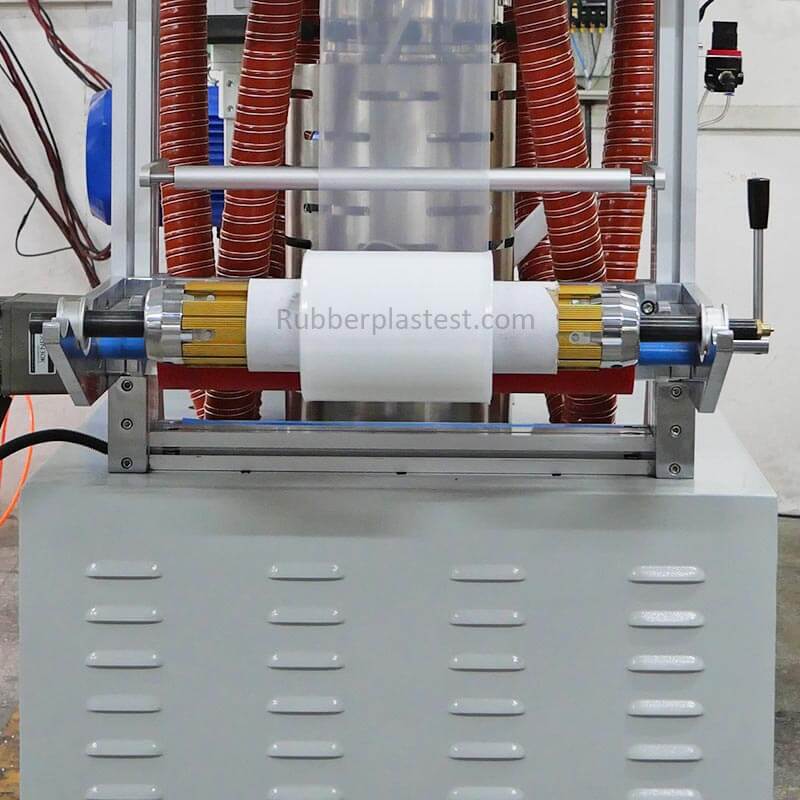
The extruder comes standard with one zone of water cooling and multiple multi-blade fans to cool specific channels as needed. The blower automatically activates for cooling in case of overheating. Our standard die ring diameter for the standard blown film machine is 25mm; other diameters are available upon request. The die head is made of alloy steel and heat-treated; the spiral flow channel is chrome-plated and polished to achieve micron-level blown film thickness. The machine has a built-in air compressor and blower, eliminating the need for users to prepare them separately at the testing site. The air compressor provides compressed air from the die orifice to inflate the film preform, while the blower rapidly cools and shapes the film bubble from the outside. A pair of nip rolls directly above the die flattens the film bubble and transports it to the next stage. To ensure the film bubble stabilizes during cooling and smoothly transitions from a cylindrical shape to a flattened form, a bubble stabilizer and collapsing frame are installed between the nip rolls and the die orifice. The flattened double-layer film, guided by several guide rolls, finally reaches the winding stage. This compact film blow line uses friction winding to complete the winding of the finished film. Instead of directly driving the final roll (paper tube) with a motor to complete the winding, it uses a motor to drive a rubber roll adjacent to it. As the film passes between the two rolls, the friction between them “pulls” the film to complete the winding. This method results in stable tensile force, good winding quality, and simple operation, adapting to films of different materials and thicknesses. To allow users to check on-site whether the blown film meets quality standards, the machine is equipped with an LED panel light, which allows for clear observation of the dispersion of the raw material, the glossiness, and the uniformity of the finished product before the film is rolled up. Finally, it’s important to emphasize that our blown film machine’s control system uses a SIEMENS PLC-supported touchscreen. It features a user-friendly human-machine interface. You can set and change various test parameters on the touchscreen, such as the melt temperature, screw speed, nip roll speed, and control various machine operations, such as starting and stopping the machine, the air compressor and blower. You can monitor the equipment’s operating status in real time, such as temperature, pressure, and rotation speed, through this screen. In short, this touchscreen makes it very easy for you to use this blown film extrusion line.
Lab Blown Film Extruder - Technical Specifications
Model | AT-P6110-25 | AT-P6110-25-3 |
Name | Singe-layer film blowing machine | Three-layer co-extrusion film blowing machine |
Screw diameter | 25 mm or specified | 25 mm x 3 pieces or specified |
L/D of screw | 33:1 or specified | |
Screw speed | 0~95 rpm frequency control | |
Motor | Variable frequency motor or servo motor | |
Main motor power | 4 kW or specified | |
Blowing fan | 0.25 kW or specified | |
Die diameter | 25 mm or specified | 25 mm or specified |
Max. Diameter of the produced film | 150 ~ 180 mm or specified | 300 mm or specified |
Dimensions | 1800 mm (W) × 800 mm (D) × 2000 mm (H) | 2100 mm (W) × 950 mm (D) × 2300 mm (H) |
Weight | Appr. 450 kg | Appr. 1100 kg |
Power supply | 3∮,AC380 | |
Lab Monolayer Blown Film Extruder Video
Lab Monolayer Blown Film Extruder Features
- The machine features an integrated design, minimizing its footprint.
- The blown film extruder screw can be customized to meet different material and testing requirements.
- The screw and barrel are precision machined and nitrided.
- The extruder barrel has a stainless steel casing to reduce heat loss, prevent user burns, and enhance aesthetics.
- The traction motor uses stepless speed regulation to adapt to different extrusion speeds.
- Supports multi-zone heating and independent temperature control.
- Water and air cooling are available.
- A melt pressure monitoring device can be configured as needed.
- Equipped with a SIEMENS PLC touchscreen human-machine interface.
- Die size can be customized.
- The machine includes an air compressor and blower.
- The traction roll and take-up roll have independent frequency-controlled motors with controllable speeds.
- Equipped with an emergency stop device and various safety devices.
- A standard LED observation light is included for finished product quality inspection.
- An air shaft is included to accommodate different sizes of take-up paper roll.
- The machine is simple to operate and easy to maintain.
Get Free Quote of Lab Monolayer Blown Film Extruder that Best Meets Your Needs
Tell us about your unique testing requirements to get a personalized solution from AmadeTech
Related Products
Related Posts