Skip to content
Lab Twin Screw Strand Pelletizing System
Model
AT-P6140 series
Applications
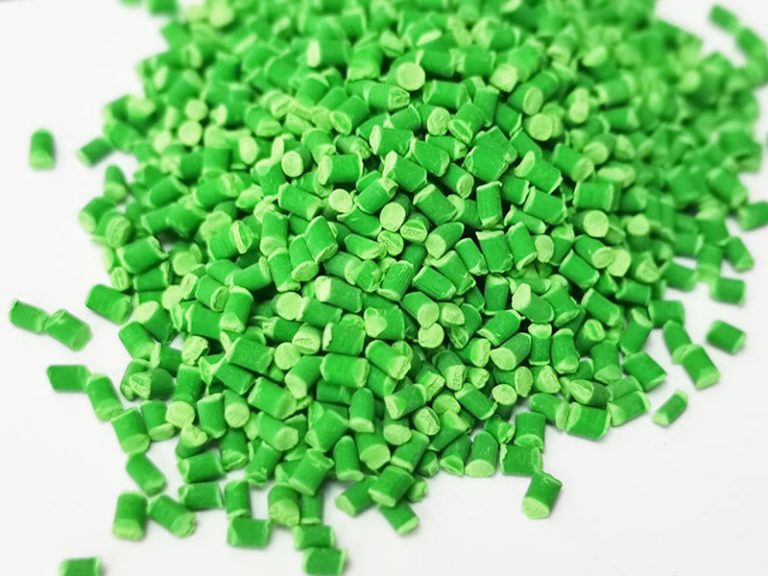
It is used to transforms powdered materials into molten plastic polymers and then into uniform cylindrical plastic pellets.
Lab Scale Water-cooled Strand Pelletizer Overview
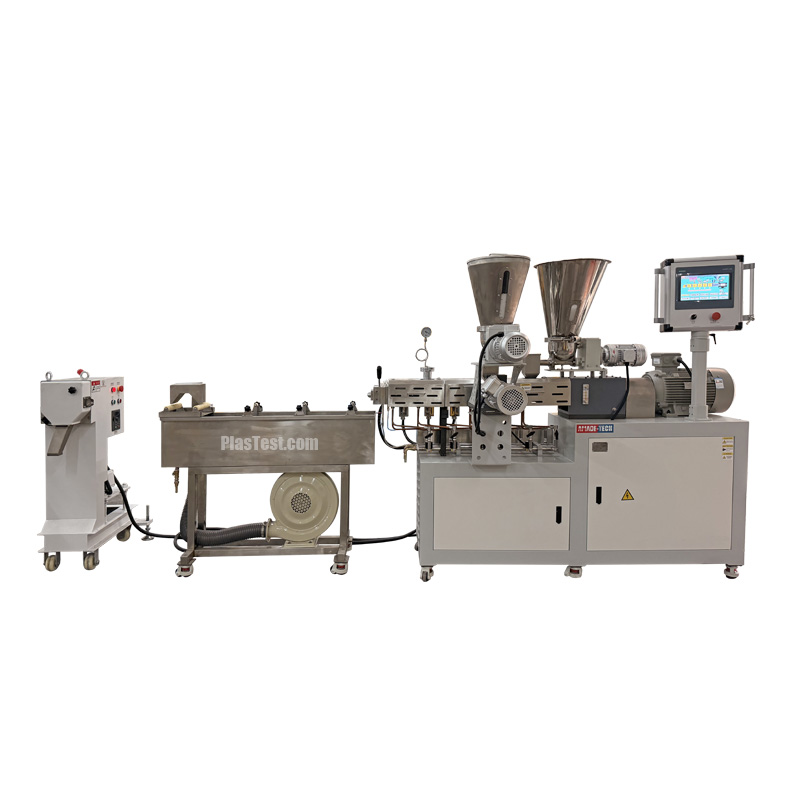
The Lab Twin Screw Strand Pelletizing System is a miniaturized laboratory pelletizing line that transforms powdered materials into molten plastic polymers and then into uniform cylindrical plastic pellets. It primarily consists of a twin-screw extruder, a cooling water trough, a blower, and a pelletizer. Unlike production-type granulator machines, the laboratory small granulation extrusion line is more compact in design, offering higher control accuracy and more convenient operation. It is mainly used for small-scale pellet production trials, simulated production, testing, and process optimization, and is suitable for mixing and processing experiments with engineering plastics, modified plastics, waste plastics, and masterbatches.
Pellet Making Principle
The polymer raw materials, weighed according to the formula, are placed into the hopper of the extruder and fed into the barrel at a set speed. Under the combined action of strong shearing, extrusion, and electric heating systems from two parallel, meshing, co-rotating screws, the material is melted and mixed into a homogeneous melt. Volatile substances in the melt are removed by a connected vacuum system as it flows through the exhaust section. Subsequently, the melt is extruded from the die head into multiple continuous noodle-like strands by the screws. The extruded strands enter a cooling water basin for cooling and hardening, and after passing through the air vents of a blower to remove surface moisture, they enter a pelletizer where they are cut into uniform cylindrical particles by rotating blades.
Detailed Description of Equipment Structure
The extruder is the core component of the entire granulation production line, primarily used to melt materials and process them into strands with specific cross-sections. Its core component is the screw, responsible for conveying, compressing, melting, and homogenizing the plastic. Our machine’s screw uses imported alloy steel W6M05Cr4V2, achieving an overall hardness of HRC58-62 after vacuum heat treatment. It boasts high torque, excellent dispersibility, and reduces material contamination caused by screw wear. Two screws are arranged in parallel and rotate in the same direction. The screws employ a modular design, with the threaded assembly connected to the mandrel via an involute spline, facilitating assembly and disassembly. We can flexibly adjust the screw length-to-diameter ratio, screw arrangement, venting volume and position, and feeding method according to the processing materials and process formulation requirements, further optimizing the configuration to meet different material and process requirements. Furthermore, based on the basic parallel twin-screw structure, a self-cleaning module is added. The powerful thrust of the self-cleaning module removes residue from the screw tip, preventing contamination in subsequent tests and significantly improving testing accuracy and efficiency. Based on the user’s production capacity requirements and material characteristics, we can provide screw diameters of different sizes, including 25mm, 35mm, 40mm, 45mm, etc.
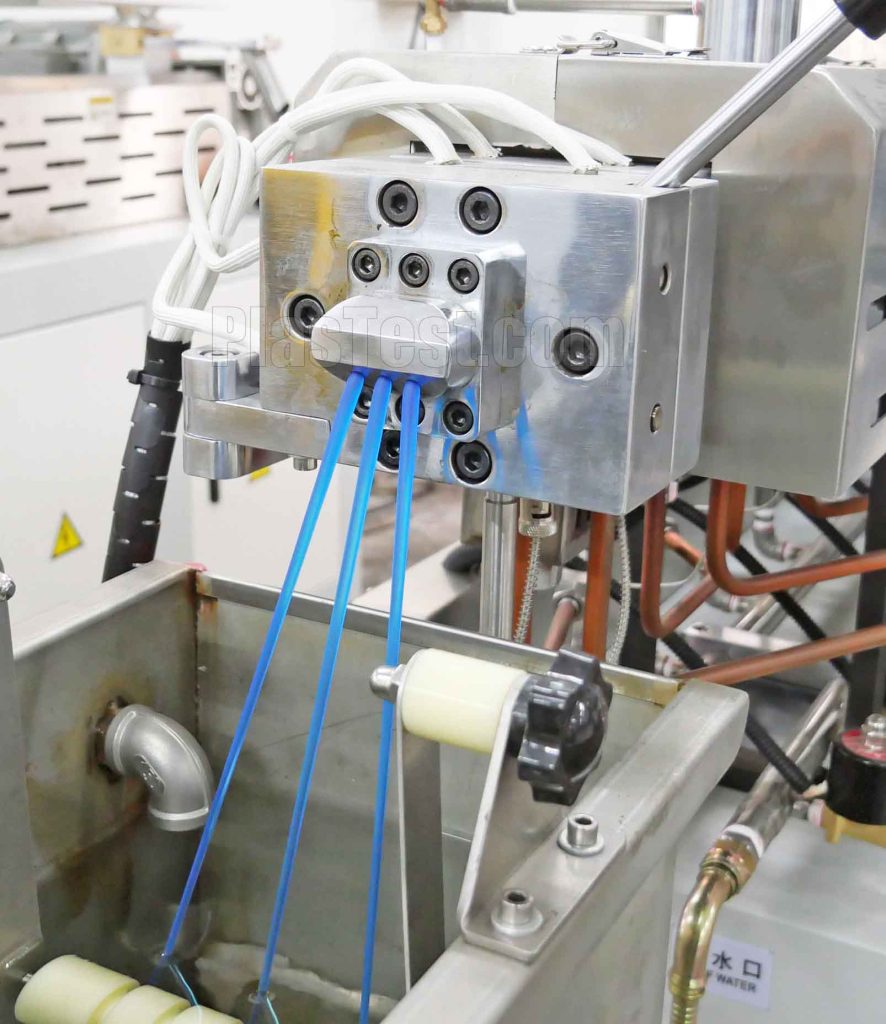
Extrusion die
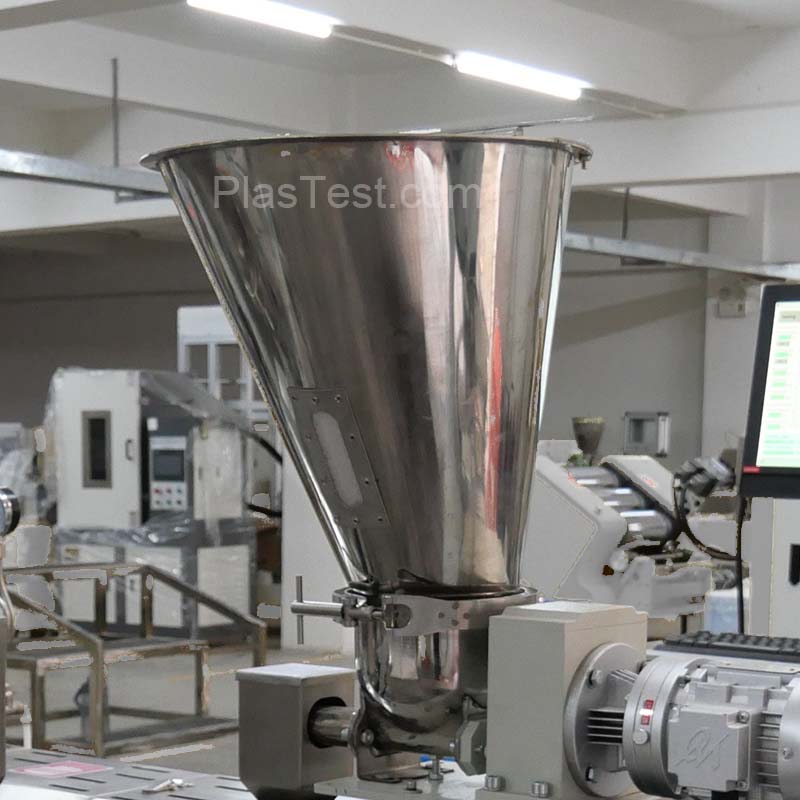
The hopper is made of stainless steel and has an observation window to monitor whether feeding is needed during machine operation. The feeding speed is controlled by a pair of independent feed screws, which can be freely set and work in conjunction with the screws inside the barrel according to a set ratio, thereby precisely controlling the material supply.
The barrel is also made of high-quality wear-resistant alloy steel, featuring a segmented structure design, with each segment 120 mm long. It has multi-stage electric heating and independent control functions. A water-cooling channel is installed inside the barrel for automatic material cooling when needed. The fourth section of the barrel is equipped with a vacuum exhaust port and a vacuum gauge. When the vacuum pump is working, it removes water vapor and volatiles from the molten material and dissolves them in water, improving the purity of the extrudate.
The control system uses a German Siemens PLC touch screen as the human-machine interface. There are different virtual buttons on the LCD display for users to input various parameters such as temperature and speed and issue operating instructions by touching their fingers, and display the current parameters and the operating status of the machine in real time. The humanized interface design is intuitive and easy to understand, which is convenient for users to operate and use.
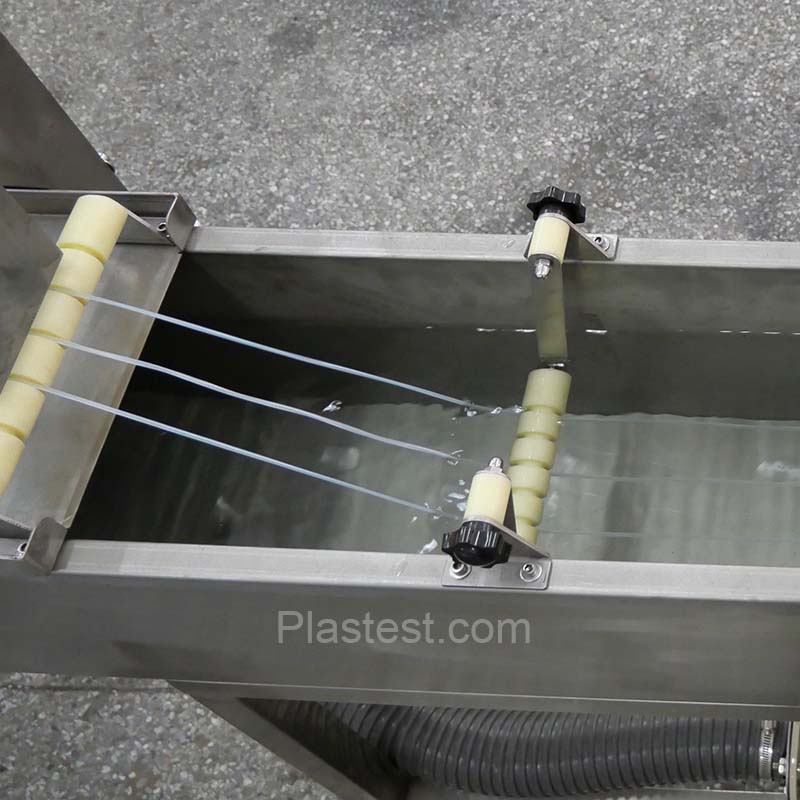
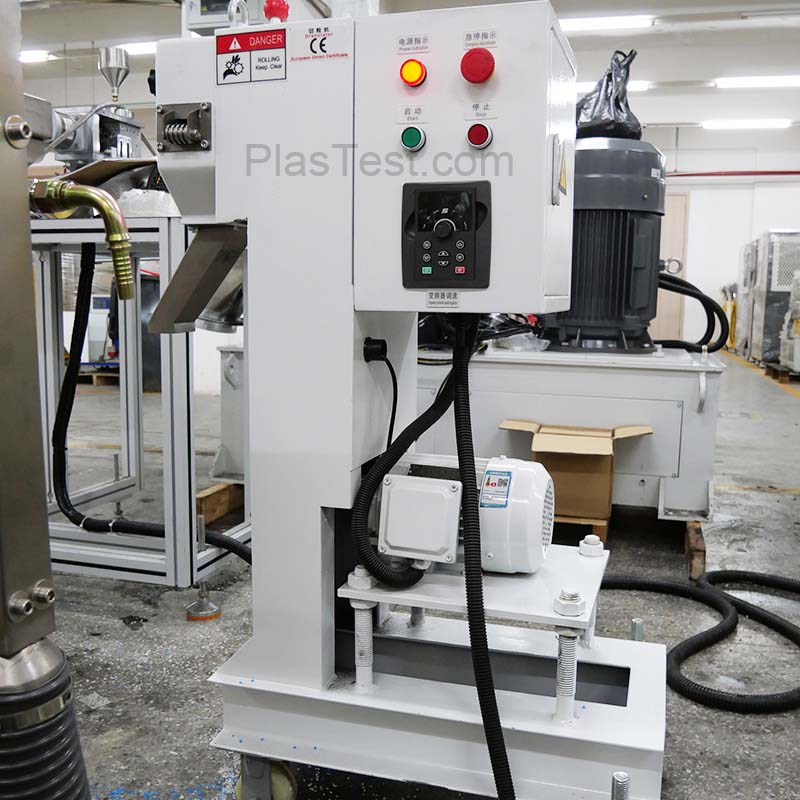
After the melt is extruded from the die, it is immersed in water in a water bath for cooling and solidification. A blower at the bottom of the water bath blows cold air to remove surface moisture from the freshly extruded strips, which are then conveyed into the feed inlet of an electric pelletizer. Under the rapid rotation of the rotary blades, the strips are uniformly cut into cylindrical pellets for subsequent testing.
Lab Twin Screw Strand Pelletizing System Technical Specifications
Model No | AT-P6140-25 | AT-P6140-35 | AT-P6140-40 |
Control system | PLC control | ||
Capacity | 1~10kg/h ( subject to formula ) | 30kg/h(subject to formula ) | 60kg/h(subject to formula ) |
Feeding machine | Quantitative feeding or specified | ||
Screw diameter | 21.7 mm or customized | 35 mm or customized | 40 mm or customized |
L/D | 1:40 | 1:40-48 | 1:48 |
Screw speed (rpm) | 0-300 | 0-500 | 50-500 |
Cooling device | Air/water cooling (optional) | ||
Cutting device | Water strand/Hot cutting/underwater cutting | ||
Power Supply | 3∮,AC380 or specified | ||
Lab Twin Screw Strand Pelletizing System Video
Lab Twin Screw Strand Pelletizing System Features
- The main motor is a Siemens brand.
- The feeding speed of the feed hopper is controllable.
- The feeding speed and screw speed can be linked.
- Side feed ports can be configured according to material properties and processing requirements.
- Screw patterns and parameters can be customized for different materials.
- The barrel supports multi-zone heating and independent control.
- The barrel supports water cooling with automatic water supply in case of overheating.
- The vacuum system is equipped with a condenser to decompose volatiles. The number and size of die orifices can be customized.
- The cooling water tank can dynamically add and drain water.
- The pelletizing speed and pellet height are adjustable.
- A built-in blower quickly removes water from the surface of the pellets.
- Equipped with a Siemens PLC touchscreen controller for convenient and reliable operation.
- Equipped with various emergency stop and other safety devices.
Get Free Quote of Lab Twin Screw Strand Pelletizing System that Best Meets Your Needs
Tell us about your unique testing requirements to get a personalized solution from AmadeTech
Related Products
Related Posts