Skip to content
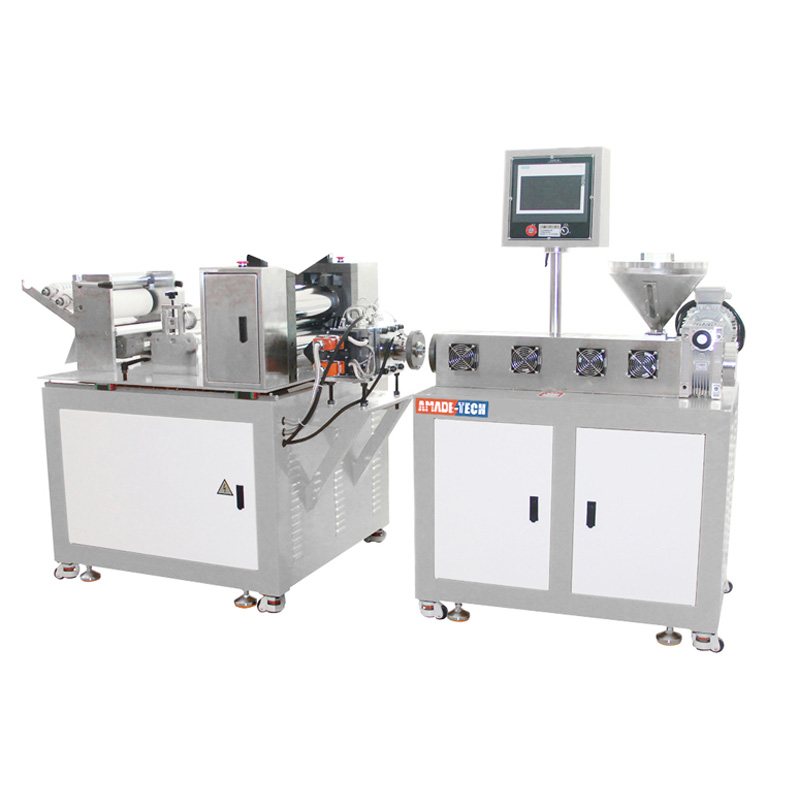
Laboratory Cast Film Line
Model
AT-P6120 series
Applications
It is used to produce ultra-thin polymer films with extremely uniform thickness and a very high surface finish.
Lab Plastic Cast Film Extruder Overview
The Laboratory Cast Film Line is primarily used for small-scale production of ultra-thin polymer films with extremely uniform thickness and a very high surface finish. It is equipped with a single-screw extruder that heats, melts, and plasticizes plastic particles such as PP, PE, and PLA, then extrudes them into thin sheets through a T-die. These sheets are then rapidly cooled and shaped on cooling rolls, followed by edge trimming and winding. Under near-real-world production conditions, it produces film samples with narrow widths, precise thickness, and controllable performance. It is mainly used for the research and development of new plastic formulations, the verification and improvement of production processes, and the preparation and performance testing of film samples. Compared to production-grade cast film machines, it offers higher film-forming precision, a smaller footprint, material savings, and more intelligent control.
How the Lab Cast Film Line Works
Plastic raw materials are fed into the hopper of an extruder. Under the heating of the barrel and the extrusion and shearing action of the rotating screw, the material is melted into a uniform viscous flow state. The melt is pushed to a flat T-die and extruded from the slot die to form a high-temperature, still-flowing “melt curtain.” This curtain then adheres tightly to a cooler mirror-finish cooling roll, where the melt is rapidly cooled and solidified, transforming from a viscous flow state into a solid film. The cooled film passes through a series of guide rolls, is trimmed, and conveyed to a winding device, where it is neatly wound into a roll under constant tension control for subsequent testing.
Detailed Description of Equipment
A laboratory cast film extruder mainly consists of a single-screw extruder, a casting die, cooling rolls, multiple guide rolls, a trimming device, and a winding device. The extruder is standardly equipped with a screw 825mm long and 25mm in diameter. Both the barrel and screw are made of high-quality 38CrMoAlA nitrided steel, with a nitriding depth of 0.4–0.7mm. The screw is driven by a Siemens motor, with the speed adjusted by a frequency converter, reaching a maximum of 95 RPM. Both the barrel and die of the extruder are equipped with cast aluminum electric heaters to provide the required processing temperature. Cooling is achieved through a combination of water cooling and fan cooling. The casting die is made of alloy steel and is polished and chrome-plated to achieve the required precision. The die width can be customized according to the sample width, and the internal flow channel uses a coat hanger design.
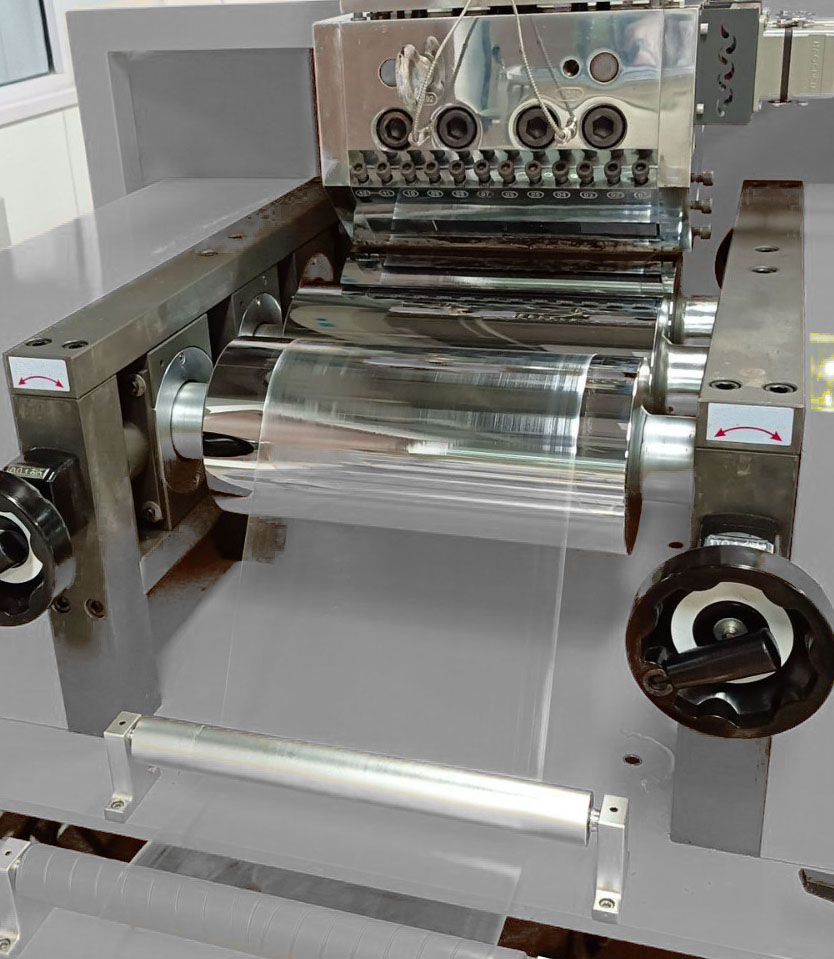
Cast film rolls
Depending on the melt index of the material and the processing requirements, the slot die can perform horizontal extrusion and downward extrusion. The cooling rolls consist of at least two horizontally or vertically arranged mirror-plated chrome rolls (and may also include chrome-plated roll(s) and one rubber roll depending on the process requirements). The chrome-plated roll has internal cooling water circulation to cool and shape the film. A chiller can be optionally added to further cool the circulating water for even better cooling. If the sheet material leaving the casting die requires further control over thickness and surface smoothness, we can place calendering rolls immediately adjacent to the die. Calendering rolls typically consist of two or more precision rollers with finely adjustable gaps. As the melt passes through these precise gaps, it is “rolled” into sheets with uniform thickness and a highly smooth surface. The winding unit includes a variable frequency motor, winding roll, and expansion shaft. The winding speed is adjustable. Friction winding is used to roll the film onto the paper tube.
The machine’s controller is based on a 10-inch Siemens PLC touchscreen. You can operate, control, and monitor the machine on this screen.
In short, the section of the entire cast film line after the extruder can be designed and customized with great flexibility based on the characteristics of the materials being processed and the requirements of the processing technology. We welcome you to tell us your needs, and we will work together to develop a solution that suits you.
Lab Cast Film Line - Technical Specifications
Model | AT-P6120-1 | AT-P6120-3 |
Item | Single-layer cast film machine | Three-layer cast film machine |
Screw diameter | 25 mm or specified | |
Screw L/D | 33:1 or specified | |
Screw speed | 0~95 rpm adjustable | |
Die opening width | 300 mm or specified | |
Calender roll | 160 mm (D) x 350 mm (W) x 2 pcs or specified | |
Calender roll arrangement | Vertical or horizontal | |
Winding device | Friction winding | |
Power supply | 3-phase, AC 380 V or specified | |
Lab Cast Film Line Video
Lab Cast Film Line Features
- The machine body is welded from structural steel and subjected to stress treatment, resulting in high rigidity and minimal deformation.
- Modular design allows for flexible installation and use.
- Small footprint and flexible configuration.
- The hopper supports rapid unloading.
- The configuration of each machine component can be customized according to material characteristics and process requirements.
- Die head size is customizable.
- Equipped with a PLC-supported touchscreen for human-machine interaction.
- English/Chinese interface can be switched at any time.
- Cooling of the casting rolls supports ordinary water cooling or chiller cooling.
- The film edges can be trimmed on both sides.
- The entire machine is equipped with adjustable feet and casters.
- Simple operation and easy maintenance.
Get Free Quote of Lab Cast Film Line that Best Meets Your Needs
Tell us about your unique testing requirements to get a personalized solution from AmadeTech
Related Products
Related Posts